
Slope Aspect
We know we haven't gone far and we're somewhere within this circle of map
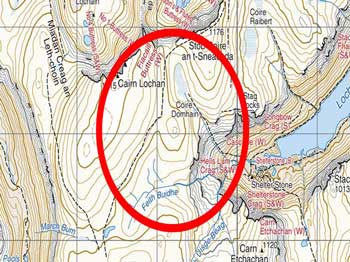
Using slope aspect can be a very useful tool to help you relocate. In its simplest form just use the points of the compass - north, east, south and west - to work out which direction the slope you are on is facing and then look at the map to find the slope which faces this way.
Slope aspect can be used more precisely by taking a bearing of the direction in which the slope faces.
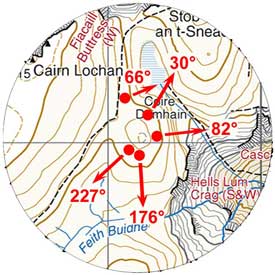
We've taken a bearing of the direction in which the slope we are on drops away. There can be slopes of very different directions all located within a small area. The task is to find out which slope you are on.
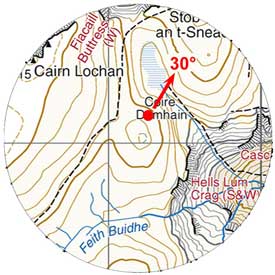
Let's assume the bearing we took of the slope on the ground was 30°
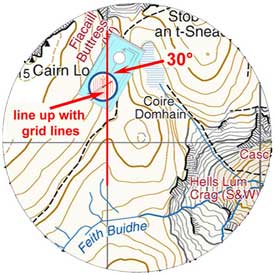
Place the compass on the map in the rough area where you know you are. You have already got 30° set on the compass because you've just taken the bearing of the slope direction. Without moving the compass housing, turn the whole baseplate until the parallel lines in the compass housing line up with the grid lines on the map
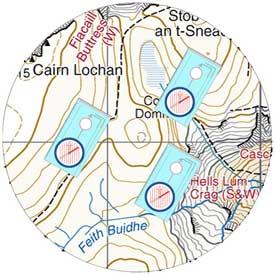
Move the compass around the area you're in until the edge of the baseplate is at right angles to the contours of the slope you think you are on. Make sure you keep the bearing set on the compass
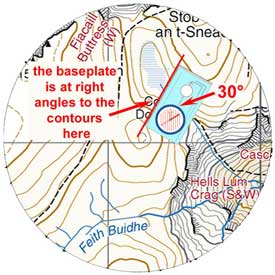
Make sure you line up the parallel lines in the compass housing with the grid lines. Only move the compass baseplate, don't turn the compass housing because this will change the bearing you have taken
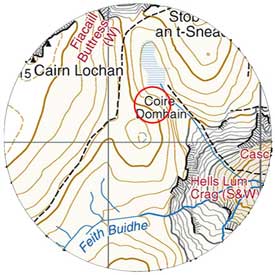
This is the slope which you have identified. Usually there will only be one slope in the area you are in which faces a particular direction and so this gives you some quality information about your likely location
To be really accurate you can subtract the magnetic variation from the bearing you took on the ground but this isn't strictly necessary because the bearing you have taken is only approximate anyway.
This page reproduced with the kind permission of the Mountaineering Council of Scotland (MCofS). They run a number of Mountain safety courses, Seminars and Lectures. You can join the MCofS here